
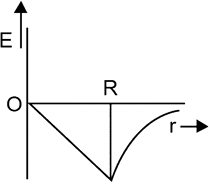
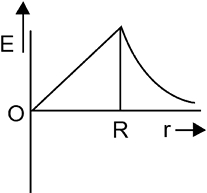
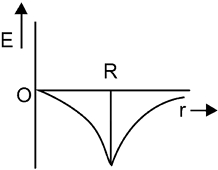
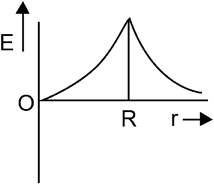
The dependence of the intensity of the gravitational field $(E)$ of the Earth on the distance $(r)$ from the center of the Earth is correctly represented by:
- A
- B
- C
- D
Explore More
Similar Questions
Three point masses,each of mass $m$,are kept at the corners of an equilateral triangle of side $L$. The system rotates about the center of the triangle. The period of rotation $T$ is directly proportional to:
Three particles of mass $1 \, kg$ each are placed at $(0, 0)$,$(0, 0.2 \, m)$,and $(0.2 \, m, 0)$. What is the net gravitational force on the particle placed at the origin?
Difficult
View SolutionThe gravitational force acting on a particle,due to a solid sphere of uniform density and radius $R$,at a distance of $3 R$ from the centre of the sphere is $F_1$. $A$ spherical hole of radius $(R / 2)$ is now made in the sphere as shown in the figure. The sphere with hole now exerts a force $F_2$ on the same particle. The ratio of $F_1$ and $F_2$ is
DifficultTS EAMCET 2013
View SolutionThe mass density of a spherical body is given by $\rho(r) = \frac{k}{r}$ for $r \leq R$ and $\rho(r) = 0$ for $r > R$,where $r$ is the distance from the centre. The correct graph that describes qualitatively the acceleration,$a$,of a test particle as a function of $r$ is
DifficultJEE MAIN 2017
View Solution$A$ satellite of mass $m$ is at a distance $a$ from a star of mass $M$. The speed of the satellite is $u$. Suppose the law of universal gravity is $F = -G \frac{Mm}{r^{2.1}}$ instead of $F = -G \frac{Mm}{r^2}$. Find the speed of the satellite when it is at a distance $b$ from the star.
Difficult
View SolutionVedclass Products
For Students
Vedclass Test Series
Mock tests in real JEE/NEET style with performance analysis. 5-day free trial.
Start Free TrialFor Teachers
Exam Paper Generator
Generate Set A/B/C/D exam papers from 7.5L+ questions in 2 minutes. 3 chapters free.
Try FreeFor Institutes
Online Exam Module
Live online exams with unlimited students, 360° analytics & white-label branding.
See Demo